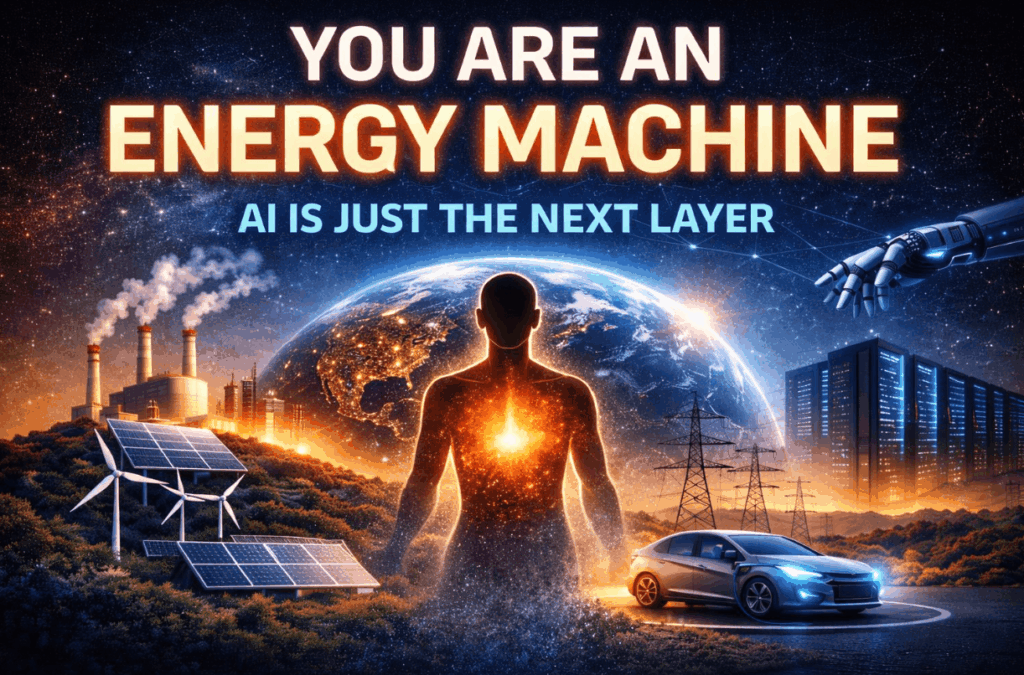
Before we argue about an “AI energy crisis,” let’s start somewhere simpler: you.
Not your job. Not your opinions. Not your productivity stack.
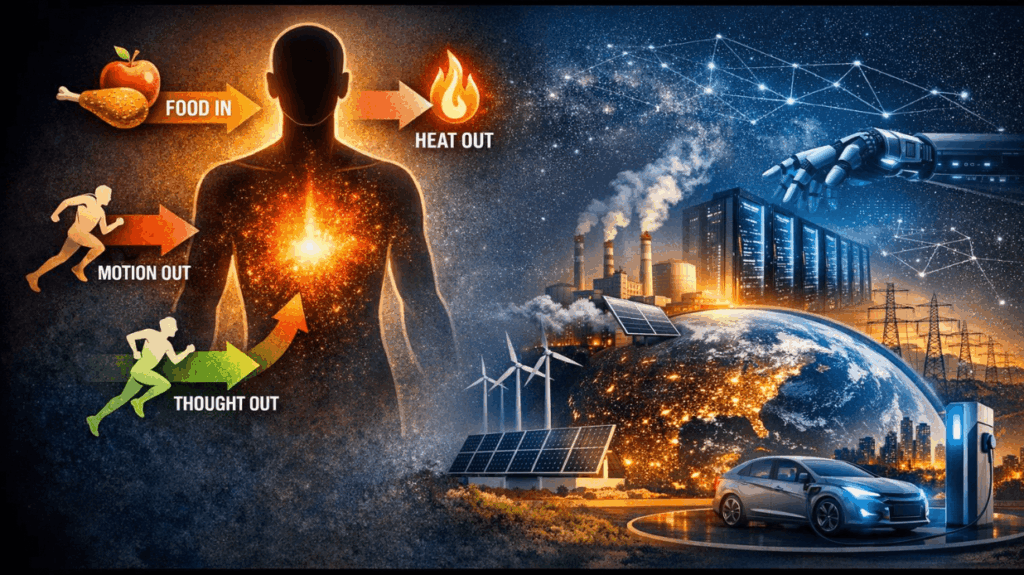
At the most fundamental level, you are an energy converter. Food goes in. Heat, motion, and thought come out. Everything else — cities, factories, AI models — is simply stacked energy systems built on top of biology.
Let’s walk through this slowly. The numbers are surprisingly grounding.
How Much Energy Does a Human Actually Need?
Globally, the average physiological requirement is about 2,160 kilocalories per person per day. When we convert that into electricity units — where 1 kcal equals 0.001162 kWh — it comes out to roughly 916 kilowatt-hours per person per year.
That’s it.
To keep one human alive for a full year, you need about 916 kWh of metabolic energy. Think of it this way: your body runs continuously on roughly the power draw of a small 100-watt bulb. You are a quiet, highly efficient biological engine — running 24/7, every day of your life.
Multiply by 8.2 Billion Humans
The world population is approximately 8.2 billion people. When you multiply 916 kWh by 8.2 billion, the total annual metabolic energy required to keep humanity alive comes out to about 7,514 terawatt-hours per year.
Spread across the year, that equals roughly 0.86 terawatts of continuous power.
That number — 0.86 TW — represents the energy required to simply keep the human species alive. No cars. No planes. No Netflix. No AI clusters humming in data centres. Just breathing, thinking, and circulating blood.
Here’s the Twist — We Already Produce More Food Energy Than We “Need”
According to global dietary supply data, the world actually provides about 2,985 kilocalories per person per day. When converted, that equals approximately 1,266 kWh per person per year. Multiply that by 8.2 billion people, and the global food system moves roughly 10,383 terawatt-hours of energy per year.
Compare that to the physiological baseline of 7,514 TWh, and we find that the world supplies about 38% more energy than the average biological requirement.
And yet people still starve.
That tells us something fundamental. The problem isn’t calorie production. It isn’t raw biological energy. It’s waste, spoilage, animal-feed conversion losses, overconsumption, unequal distribution, and broken incentives. The world already produces enough metabolic energy. The constraint isn’t scarcity — it’s coordination.
Now Zoom Out — Civilisation Is on Another Scale
Global Electricity
Annual global electricity generation is around 29,471 terawatt-hours. Compared to the 7,514 TWh required for human metabolism, that means the energy required just to keep humans alive equals about 25% of total global electricity output.
Your body matters. But civilisation operates on a far larger energy platform.
Total Primary Energy (Oil + Gas + Coal + Nuclear + Renewables)
Total global energy demand — including oil, gas, coal, nuclear, and renewables — is approximately 172,222 terawatt-hours per year.
At that scale, the human body becomes relatively small. The metabolic requirement of 7,514 TWh represents about 4.36% of total primary energy, while the 10,383 TWh supplied through food equals about 6.03%.
Biology is the foundation layer. Industry is the skyscraper built on top of it.
Where Does AI Actually Fit?
Data centres today use about 415 terawatt-hours per year, accounting for roughly 1.5% of global electricity consumption. If AI accounts for approximately 20% of that usage, AI-related electricity demand is around 83 terawatt-hours annually — or roughly 0.28% of global electricity.
Put differently, humanity uses about 7,514 TWh just staying alive, while AI consumes roughly 83 TWh thinking. As a species, we use nearly ninety times more energy than AI currently uses for computing.
So no — AI isn’t “eating the grid.”
Not today.
The Real Story Isn’t Size. It’s Speed.
Data center demand could exceed 1,000 terawatt-hours by 2026. That is rapid growth.
Unlike food energy, which is globally distributed and biologically constrained, AI infrastructure is highly concentrated in specific grids, specific regions, and even specific substations. That concentration makes the growth feel sudden and political. Local bottlenecks become national headlines.
This isn’t an energy collapse story. It’s an infrastructure scaling story.
The Big Picture
Humans are the original energy machines.
The first layer was food, which enabled survival. The second layer was fuels and electricity, which unlocked industrial civilization. The third layer — now emerging — is electricity converted into intelligence at scale.
AI isn’t a separate crisis. It is simply a new industrial load being added to an energy system that is already expanding to support electric vehicles, electrified heating, green steel, and advanced manufacturing.
The real constraint isn’t imagination. It’s built speed.
Final Thought
We don’t have an AI problem.
We have a power expansion problem.
The next trillion-dollar companies won’t just build better algorithms. They’ll build faster transmission systems, scalable storage, modular nuclear reactors, smarter grids, and rapid permitting frameworks.
Because in the end, civilization runs on a simple equation:
Energy in → Complexity out.
And civilisation only moves as fast as its power supply.